
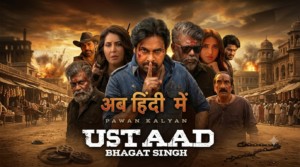
Ustaad Bhagat Singh at a Glance
Ustaad Bhagat Singh is a 2026 Telugu-language action drama directed by Harish Shankar and headlined by Pawan Kalyan, with Sreeleela, Raashii Khanna, R. Parthiban, K. S. Ravikumar, Ramki, Gautami, Ashutosh Rana and others in supporting roles. The movie arrived in theatres on March 19, 2026, during the Ugadi festival period, after years of anticipation surrounding the reunion of Pawan Kalyan and Harish Shankar. The official film details list Harish Shankar as writer-director, while Mythri Movie Makers backed the production.
The movie was always going to be judged against a giant commercial-cinema benchmark because Pawan Kalyan and Harish Shankar previously worked together on Gabbar Singh, a film that became a major part of the actor’s mass image. That history created excitement but also raised the bar considerably. Once the movie was released, the response turned out to be mixed: critics generally appreciated Pawan Kalyan’s charisma and screen presence but questioned the freshness of the writing, pacing, comedy and overall commercial formula. The Times of India gave the movie 2.5/5, while The Indian Express rated it 1.5/5, showing just how divided the critical response was.


Release Date, Runtime and Genre
The film was released theatrically on March 19, 2026, and runs for approximately 2 hours and 34 minutes according to BookMyShow and the Central Board of Film Certification listing. It is primarily an action-oriented commercial entertainer, combining drama, comedy, romance, political themes and large-scale hero moments. The CBFC record lists the film as U/A 16+ and records a certified length of 154 minutes.
| Feature | Details |
|---|---|
| Movie | Ustaad Bhagat Singh |
| Release Date | March 19, 2026 |
| Language | Telugu |
| Genre | Action, Drama, Comedy |
| Director | Harish Shankar |
| Lead Actor | Pawan Kalyan |
| Female Leads | Sreeleela, Raashii Khanna |
| Production | Mythri Movie Makers |
| Runtime | About 2 hours 34 minutes |
| Music | Devi Sri Prasad |
| Background Score | S. Thaman |
| Cinematography | Ayananka Bose |
| Editor | Karthika Srinivas |
Ustaad Bhagat Singh Story Explained
At its heart, Ustaad Bhagat Singh is a story about a man whose identity and worldview are shaped by a teacher who believes education can change lives. The official synopsis describes Bhagat Singh as a tribal boy influenced by his teacher and given the name “Bhagat Singh.” As he grows older, the values taught to him become the foundation for his courage, morality and determination to confront injustice. Eventually, his journey takes him toward becoming a police officer who refuses to remain passive when powerful forces exploit ordinary people.
The Indian Express provides additional story details, describing the teacher as a welfare-minded figure working among tribal communities in Andhra Pradesh. The teacher encounters a courageous tribal child, gives him the name Bhagat Singh and helps shape his education and social conscience. The story then moves forward as Bhagat becomes a police officer, while the teacher’s own journey eventually takes him into politics and the position of Chief Minister. The central conflict develops around Bhagat’s confrontation with corrupt and powerful forces, giving the film the familiar framework of a righteous hero taking on a system that appears bigger than himself.
Bhagat Singh’s Origins and Core Motivation
The character’s backstory is important because the film wants Bhagat Singh to represent more than physical strength. His teacher’s influence gives him a moral foundation, while his experiences shape his belief that authority should be used to protect people rather than intimidate them. This creates the basic contrast between Bhagat and the antagonistic forces around him: one side believes power comes from fear, while the other believes power has meaning only when it serves justice.
That idea sounds straightforward, and it is. The challenge is that the film sometimes presents these themes through direct speeches and hero-elevation scenes rather than allowing them to emerge naturally from the characters’ choices. This is one of the reasons critics who wanted a fresher modern action drama found the narrative dated. The Indian Express specifically argued that serious subjects such as political integrity and social issues are introduced but not explored deeply enough.
Pawan Kalyan as Bhagat Singh
If there is one element that consistently carries Ustaad Bhagat Singh, it is Pawan Kalyan. The actor’s screen presence remains the movie’s most obvious advantage, particularly when Harish Shankar gives him room to deliver a punchline, enter a confrontation or dominate an action sequence. Even critics who disliked the overall writing acknowledged that Pawan Kalyan can lift scenes through his charisma, body language and dialogue delivery. The Indian Express specifically praised his styling, dancing, comedy timing and ability to command action sequences.
Pawan’s performance is built around the classic larger-than-life commercial hero template. He does not need to shout every line to create an impact; pauses, expressions and controlled movement often do the work. For longtime fans, this is probably the closest thing to a comfort-food performance, because the movie repeatedly gives them familiar ingredients: swagger, attitude, punch dialogues, dramatic entrances and action scenes designed for whistles.
The problem is that the character is almost too protected by the screenplay. Bhagat Singh is repeatedly positioned as the smartest, strongest and morally superior person in the room. That can work in a full-on mass entertainer, but audiences have become increasingly accustomed to heroes with vulnerabilities, contradictions and genuine character development. When a screenplay spends too much time telling viewers how extraordinary its hero is, the character can start feeling less human and more like a permanent celebration.
Sreeleela and Raashii Khanna’s Roles
Sreeleela and Raashii Khanna add two different dimensions to the film, although neither is positioned with the same narrative weight as Pawan Kalyan. Sreeleela plays Geetha, a Radio Jockey and romantic interest, while Raashii Khanna appears as Shloka. Their presence helps broaden the movie beyond its central action and political conflict, but the story remains overwhelmingly focused on Bhagat Singh.
Sreeleela gets opportunities to contribute through romance, comedy and lighter scenes, and her chemistry with Pawan provides some breathing room between the heavier action sequences. Raashii Khanna’s role is more supporting in the larger structure. Viewers expecting a character-driven female subplot may therefore find the women’s roles less substantial than the male lead’s journey.
Supporting Cast and Villain
The supporting cast includes experienced performers such as R. Parthiban, K. S. Ravikumar, Ramki, Gautami, Ashutosh Rana and Nawab Shah. K. S. Ravikumar’s performance as the teacher-turned-Chief Minister received comparatively positive attention from The Indian Express, which highlighted the maturity he brings to the role.
R. Parthiban plays a major antagonist, but this is another area where the movie struggles to make the most of its talent. A powerful hero needs a villain who can genuinely challenge him, not simply stand around waiting for the next hero-elevation moment. The Indian Express criticized Parthiban’s character as underwritten, while also suggesting that the villain lacks enough depth to become memorable.
Harish Shankar’s Direction
Harish Shankar understands Pawan Kalyan’s commercial strengths extremely well. That is both the film’s greatest asset and its biggest creative limitation. He knows how to construct an entry scene, when to pause for a dialogue, how to frame the star and where to place a mass action beat, but the movie often feels as if those individual moments were designed first and the connecting story was built afterward.
That approach can be extremely effective when the writing has freshness. Here, however, several critics felt that the film was looking backward rather than forward. The Indian Express described the movie as heavily influenced by the template of Gabbar Singh, arguing that the commercial style that worked years earlier feels dated in 2026. The Times of India reached a similar conclusion, calling the film a passable commercial action drama while criticizing its lack of novelty.
Action and Mass Entertainment
Action is clearly one of the major selling points of Ustaad Bhagat Singh. The film gives Pawan Kalyan multiple opportunities to demonstrate physical dominance, and the choreography is designed around impact rather than realism. The British Board of Film Classification’s content advice describes strong bloody violence, including shootings, stabbings, beatings and other intense fight material, so viewers should not expect a lightweight action comedy.
The action works best when it is connected to Pawan’s screen persona. His physicality and attitude give even familiar fight setups a certain theatrical energy. You can almost picture the intended audience response: the hero appears, the music rises, the villain’s confidence disappears and the theatre erupts. That is classic Telugu mass-cinema construction, and fans who enjoy that style will probably find several sequences entertaining.
Fight Choreography and Hero Elevation
The movie’s biggest action weakness is repetition. When every major confrontation has to become a celebration of the hero, the suspense gradually disappears. If the audience knows Bhagat Singh will walk through every opponent, then the question becomes less “How will he survive?” and more “What style will his next victory take?”
That can still be enjoyable, particularly for fans watching with a crowd. But modern action cinema increasingly mixes spectacle with tactical storytelling, character stakes and consequences. Ustaad Bhagat Singh is more interested in the theatrical experience than in creating a realistic or unpredictable combat narrative. That is not necessarily a flaw if you know what kind of movie you are buying a ticket for.
Comedy, Dialogues and Emotional Moments
Harish Shankar’s commercial formula traditionally relies on a mixture of comedy, punch dialogues and hero-centric humour. In Ustaad Bhagat Singh, some of these moments land because Pawan Kalyan has strong comic timing and an effortless ability to sell a line. Other jokes feel like they belong to an earlier era of commercial cinema and do not always connect with the same force.
The Times of India noted that the first half contains comedy that does not consistently land, while the Indian Express also criticized the film’s dated commercial treatment. This is important because comedy is often the glue that holds a long mass entertainer together. When the jokes work, a predictable story can still feel lively; when they miss, the gaps between action scenes become much more noticeable.
The emotional material has a similar issue. The relationship between Bhagat and his teacher provides the story with genuine potential, especially because education and moral responsibility are central to Bhagat’s identity. Yet the screenplay frequently chooses speeches and dramatic declarations over quieter emotional development. The result is a movie that tells you what its characters believe more often than it allows you to discover those beliefs through their behavior.
Music and Background Score
The music department brings together Devi Sri Prasad and S. Thaman, with DSP credited for the music and Thaman handling the background score. That combination creates high expectations because both composers have strong histories in Telugu commercial cinema. The official production credits confirm their respective roles.
The response, however, was not as enthusiastic as the star pairing might suggest. The Indian Express described the album as mediocre overall, while noting that “Dekhlenge Saala” stood out more positively than the other songs. It also considered the background score fairly standard and suggested that the rushed production circumstances may have affected it.
For a movie built around hero elevations, background music is particularly important. A great score can transform an ordinary entrance into a memorable cinematic moment. Here, the music supports the spectacle but does not consistently reach the kind of explosive level many fans might have expected from a Pawan Kalyan mass vehicle.
Cinematography, Editing and Technical Presentation
Ayananka Bose handles cinematography, Karthika Srinivas is credited as editor, and Anand Sai is responsible for production design. On paper, the technical team has plenty of experience, but the final presentation divided critics.
The Indian Express was particularly critical of the visual presentation, pointing to continuity issues and a style of camerawork it considered outdated. That criticism matters because contemporary action films depend heavily on visual rhythm. A fight can have excellent choreography, but if the editing, framing or continuity makes the scene feel disconnected, some of the impact disappears.
At the same time, fans are unlikely to judge every technical choice with the same standards as a conventional drama. Ustaad Bhagat Singh is designed to be loud, theatrical and star-focused. Its visual language is intentionally commercial, even if some viewers feel that the formula needed a significant update for 2026.
What Critics Said About the Movie
The critical response was clearly mixed rather than universally negative or positive. The Times of India awarded 2.5/5, describing it as a passable watch for audiences who enjoy commercial action dramas but criticizing the lack of novelty. Its review praised Pawan Kalyan’s ability to dominate scenes while arguing that the writing feels dated.
The Indian Express was considerably harsher, giving the movie 1.5/5. Its central criticism was that the film relies too heavily on hero worship and familiar commercial beats without developing a story strong enough to support its long runtime. It also criticized the treatment of the villain, music, technical presentation and the handling of serious social themes.
| Review Source | Rating | Main Takeaway |
|---|---|---|
| The Times of India | 2.5/5 | Pawan’s presence works, but the formula feels dated |
| The Indian Express | 1.5/5 | Strong star presence cannot compensate for weak writing |
| Audience response | Mixed | Fans praised mass moments; others found it outdated |
The difference between those reviews tells you something useful: this is a movie where your enjoyment may depend heavily on your expectations. If you want a modern, tightly written action drama, the weaknesses will probably stand out. If you primarily want Pawan Kalyan’s mass persona, punch dialogues and large-scale action, you may find more value in the same material.
Audience Reaction and Fan Response
Audience reactions were similarly divided. Early reactions praised Pawan Kalyan’s screen presence, mass scenes and what some fans described as a return to his familiar style. At the same time, social-media reactions also criticized the movie for feeling outdated and overly dependent on conventional commercial formulas.
This split is not surprising. A movie built around a major star can operate almost like a concert: some viewers arrive specifically to celebrate the performer, while others arrive expecting the story to justify the spectacle. Ustaad Bhagat Singh clearly favors the first group.
That does not mean the film has nothing for general audiences. It has action, romance, comedy, political conflict and emotional themes. The issue is that those elements frequently orbit the star rather than forming an equally balanced ensemble. For Pawan Kalyan loyalists, that can be exactly what they want. For viewers looking for a story in which every character matters, it can become frustrating.
Strengths of Ustaad Bhagat Singh
The strongest aspect of the film is undoubtedly Pawan Kalyan’s screen presence. Even negative reviews acknowledge that he can command attention when the movie gives him a strong entrance, dialogue or action sequence. His ability to turn a simple moment into a theatrical event remains a major asset.
The movie also succeeds at delivering the basic ingredients of a commercial entertainer. There are fights, songs, comedy, romance, political conflict and dramatic hero moments. The production has enough scale to make the film feel like a major theatrical release rather than a small action drama.
Another strength is the underlying idea involving education, social responsibility and justice. The teacher-student relationship gives Bhagat Singh a foundation beyond simple revenge. The concept of a boy shaped by education who later becomes an officer fighting corruption could have supported a much more layered screenplay.
Weaknesses of Ustaad Bhagat Singh
The biggest weakness is writing freshness. Critics repeatedly returned to the idea that the movie feels like a commercial formula from another period. The Indian Express went further, arguing that the film attempts to recreate the spirit of Gabbar Singh without updating the formula for contemporary audiences.
Pacing is another issue. With a runtime of more than two and a half hours, a commercial film needs strong momentum. When comedy, songs or secondary scenes do not land, the runtime becomes more noticeable. The second half was particularly criticized for dragging.
The villain also needed greater depth. A hero is only as compelling as the opposition placed in front of him. If the antagonist does not feel dangerous, intelligent or emotionally connected to the protagonist, the final confrontation loses some of its power.
Is Ustaad Bhagat Singh Worth Watching?
The answer depends on what you expect from a Pawan Kalyan movie. If you are a fan who enjoys larger-than-life heroes, mass dialogues, action sequences and theatrical moments, there is enough here to justify a watch. Pawan’s performance provides several scenes that fans can enjoy even when the screenplay becomes predictable.
If you are approaching the movie as a neutral viewer expecting a fresh action drama, the recommendation is more complicated. The critical consensus points toward an entertaining star vehicle that does not completely justify its runtime or ambitions. The Times of India considered it a passable commercial watch, while The Indian Express found its dated approach difficult to overlook.
So, is it worth watching? For Pawan Kalyan fans, yes. For viewers seeking innovative storytelling, probably wait for streaming or approach it with modest expectations. That distinction captures the movie better than simply calling it good or bad.
Ustaad Bhagat Singh vs Gabbar Singh Expectations
The comparison with Gabbar Singh is unavoidable. Both films bring together Pawan Kalyan and Harish Shankar, and that earlier collaboration became a landmark in the actor’s commercial career. Naturally, audiences wanted another lightning strike.
The problem is that lightning rarely strikes twice in exactly the same place. What felt fresh and energetic in 2012 cannot simply be reproduced fourteen years later without modification. Audience tastes, filmmaking techniques and expectations around character writing have changed. Ustaad Bhagat Singh occasionally feels like it wants the audience to remember how exciting the older formula was rather than creating a new reason to be excited.
That is perhaps the fairest way to understand the movie. It is not lacking confidence; it is lacking reinvention. Harish Shankar clearly knows the commercial language he wants to speak, but some viewers may feel that the language itself needed an update.
OTT Release and Where to Watch
After its theatrical run, Ustaad Bhagat Singh moved toward digital distribution. Netflix India’s official trailer announcement confirmed the movie’s streaming arrival on April 16, 2026, with Telugu, Hindi, Tamil, Kannada and Malayalam language options.
That makes the film particularly easy to revisit for viewers who were curious but did not want to commit to the theatrical experience. Streaming also changes the way a movie like this is consumed. A long commercial entertainer can feel less demanding at home, where viewers can take breaks and focus on the sequences they enjoy most.
For international viewers, availability can vary by region, so checking the Netflix listing in your country is the safest approach. The official Netflix India announcement confirms the platform and multilingual availability.
Final Verdict
Ustaad Bhagat Singh is a star-driven commercial action drama that succeeds most when Pawan Kalyan is allowed to be exactly what his fans expect him to be: charismatic, confident, funny and physically commanding. The film’s strongest moments come from his screen presence, hero elevations and action sequences. The supporting cast has experienced performers, and the teacher-student foundation gives the story a potentially meaningful emotional core.
But the movie’s weaknesses are difficult to ignore. The writing often feels familiar, the villain is not developed strongly enough, the comedy is inconsistent, the music does not consistently reach the expected level and the second half loses momentum. Critics from The Times of India and The Indian Express both identified the dated commercial treatment as a central problem, although they differed considerably in how harshly they judged the result.
Ultimately, Ustaad Bhagat Singh is best viewed as a Pawan Kalyan fan-first entertainer rather than a reinvention of Telugu action cinema. It has enough mass moments to satisfy dedicated fans, but viewers expecting the freshness of a modern action blockbuster may come away disappointed. If you enjoy old-school commercial Telugu cinema and are willing to embrace the formula rather than question it, the film has its moments. If story, character depth and technical innovation are your top priorities, there are stronger choices available.
Frequently Asked Questions
1. What is Ustaad Bhagat Singh about?
Ustaad Bhagat Singh follows Bhagat Singh, a tribal boy whose teacher shapes his values and education before he grows into a courageous police officer who takes a stand against injustice and powerful corrupt forces. The story combines action, drama, romance, comedy and social themes around his journey.
2. Who plays the lead role in Ustaad Bhagat Singh?
Pawan Kalyan plays the titular character Bhagat Singh. The main supporting cast includes Sreeleela, Raashii Khanna, R. Parthiban, K. S. Ravikumar, Ramki, Gautami and Ashutosh Rana.
3. Who directed Ustaad Bhagat Singh?
The film was written and directed by Harish Shankar, marking his reunion with Pawan Kalyan after their earlier collaboration on Gabbar Singh.
4. Is Ustaad Bhagat Singh worth watching?
It depends on your taste. Pawan Kalyan fans and viewers who enjoy traditional mass-action entertainers are likely to find several enjoyable moments, while viewers looking for fresh storytelling may find the movie predictable and dated. Critical reviews were mixed, with The Times of India giving it 2.5/5 and The Indian Express giving it 1.5/5.
5. Where can I watch Ustaad Bhagat Singh online?
Netflix India announced the movie for streaming from April 16, 2026, in Telugu, Hindi, Tamil, Kannada and Malayalam. Availability can differ by country, so viewers should check the official Netflix listing for their region.